Gas chromatography
A technique for separating vaporizable compounds in a mixture.

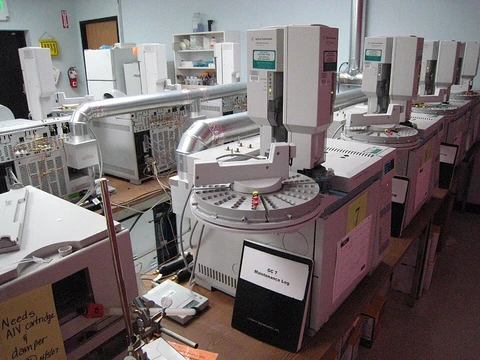
Gas chromatography (GC) is a common type of chromatography used in analytical chemistry for separating and analyzing compounds that can be vaporized without decomposition. Typical uses include testing the purity of a substance or separating components of a mixture. The technique is also known as vapor-phase chromatography (VPC) or gas–liquid partition chromatography (GLPC).
- field
- Analytical chemistry
- known_for
- Separating and analyzing vaporizable compounds
- inventors
- Anthony T. James and Archer J.P. Martin
- invention_location
- National Institute for Medical Research, Mill Hill, London
Lore & Background
The invention of gas chromatography is attributed to Anthony T. James and Archer J.P. Their gas chromatograph used partition chromatography as the separating principle. Martin and Richard Synge had noted in an earlier paper that chromatography might also be used to separate gases; Synge pursued other work while Martin continued with James. The popularity of gas chromatography quickly rose after the development of the flame ionization detector. They exhibited it at ACHEMA in Frankfurt, but nobody was interested. Other precursors include N.C. Early gas chromatography used packed columns. Resolution was improved by the invention of capillary columns, where the stationary phase is coated on the inner wall.
Reader's Guide
Gas chromatography is significant as a foundational analytical technique for separating and analyzing compounds that can be vaporized without decomposition. The technique's legacy includes its widespread use in testing purity, separating mixture components, and preparing pure compounds via preparative chromatography. The development of capillary columns improved resolution over earlier packed columns. The technique's alternative names—vapor-phase chromatography and gas–liquid partition chromatography—reflect its varied applications. The choice of carrier gas, such as helium, hydrogen, argon, or nitrogen, and the use of temperature-controlled ovens and detectors, remain central to its operation. The work of earlier researchers like Cremer, Prior, Turner, Claesson, Hesse, and Phillips provided foundational steps, though James and Martin's partition chromatography approach became the standard. Commercialization began in 1954 with Griffin and George Ltd.
Did You Know?
- Gas chromatography is also known as vapor-phase chromatography (VPC) or gas–liquid partition chromatography (GLPC).
More in Chemical Analysis And Spectroscopy 1-18
Spotted an error? Know more?
This is a living reference — every entry is fact-audited, and reader corrections feed straight into our audit queue. Suggest an edit · See this site's audit record