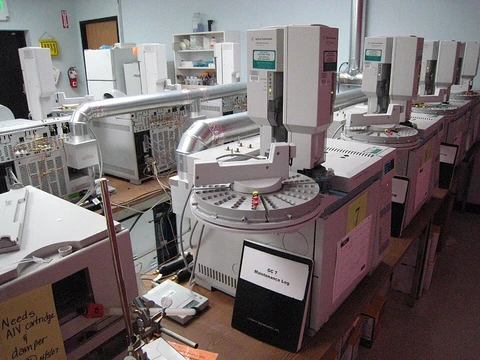
Atomic emission spectroscopy
A method using emitted light to identify and quantify elements.

Kkmurray · CC BY-SA 3.0
Atomic emission spectroscopy (AES) is a method of chemical analysis that uses the intensity of light emitted from a flame, plasma, arc, or spark at a particular wavelength to determine the quantity of an element in a sample. The wavelength of the atomic spectral line gives the identity of the element, while the intensity of the emitted light is proportional to the number of atoms. Robert Bunsen and Gustav Kirchhoff were the first to establish atomic emission spectroscopy as a tool in chemistry.
- field
- Analytical chemistry
- known_for
- Identifying elements by their unique spectral lines
- pioneers
- Robert Bunsen and Gustav Kirchhoff
- key_techniques
- Flame, inductively coupled plasma (ICP), spark and arc
- applications
- Determining chemical makeup of mixtures, pharmaceutical analytics, quality control in foundries
Lore & Background
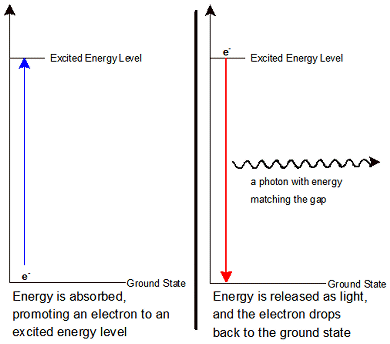
Atomic emission spectroscopy measures interactions between electromagnetic radiation and atoms. When an element is burned in a flame, its atoms move from the ground electronic state to the excited state, then emit light as they return to the ground state. The Boltzmann expression relates temperature to the number of atoms in the excited state: larger temperatures indicate a larger population of excited atoms. The wavelengths of this light can be dispersed and measured by a monochromator, and the intensity of the light determines the number of excited state electrons present.
Reader's Guide
Atomic emission spectroscopy is significant for its ability to identify elements by their unique spectral lines, making it an important tool for determining the makeup of materials. The width of spectral lines can provide information about an atom’s kinetic temperature and electron density. Different excitation methods—flame, inductively coupled plasma (ICP), and spark or arc—offer various advantages. ICP-AES provides excellent limit of detection, linear dynamic range, multi-element capability, low chemical interference, and a stable signal, though it has spectral interferences and higher cost. Spark and arc methods are used for solid metallic samples, with modern controlled discharges allowing quantitative analysis. The technique is widely used in pharmaceutical analytics and production quality control in foundries.
Did You Know?
- Robert Bunsen and Gustav Kirchhoff were the first to establish atomic emission spectroscopy as a tool in chemistry.
- The Boltzmann expression relates temperature to the number of atoms in the excited state.
- Inductively coupled plasma atomic emission spectroscopy (ICP-AES) uses an inductively coupled plasma to produce excited atoms and ions.
- Spark or arc atomic emission spectroscopy is used for the analysis of metallic elements in solid samples.
The Plasma Heart of the Instrument
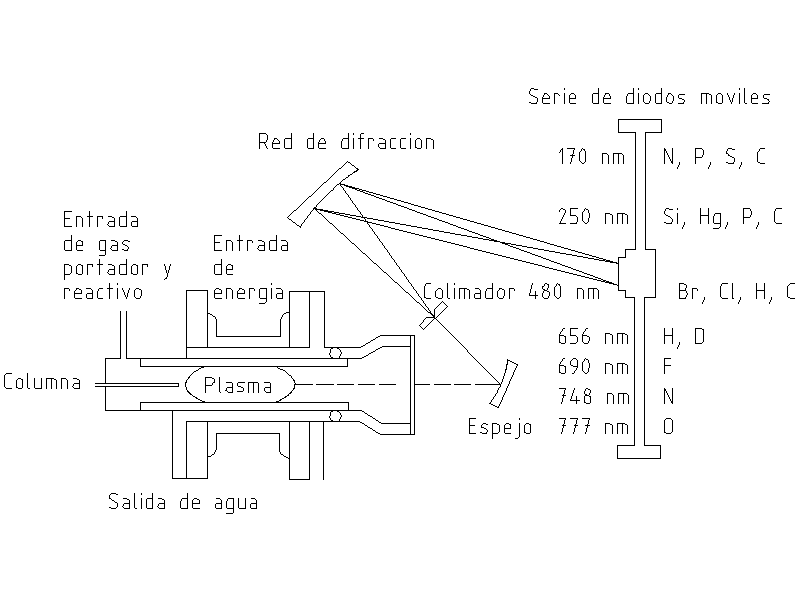
The ICP-AES system centers on a torch built from three concentric quartz glass tubes, wrapped partially by a radio frequency work coil. An RF generator—functioning much like a high-power radio transmitter—drives this coil at either 27 or 40 megahertz, producing an intense electromagnetic field. To kick-start the process, a Tesla unit fires a brief discharge arc through a stream of argon gas, initiating ionization. Once the plasma catches, the Tesla unit shuts off and the field sustains the discharge on its own. The argon, now ionized, spirals in a rotationally symmetric pattern toward the coil's magnetic field. Modern variants have even replaced argon with nitrogen. The torch operates in what is called inductive or H mode, which delivers the high plasma density needed for reliable excitation, as opposed to the lower-density capacitive E mode.
From Liquid Sample to Measured Wavelength
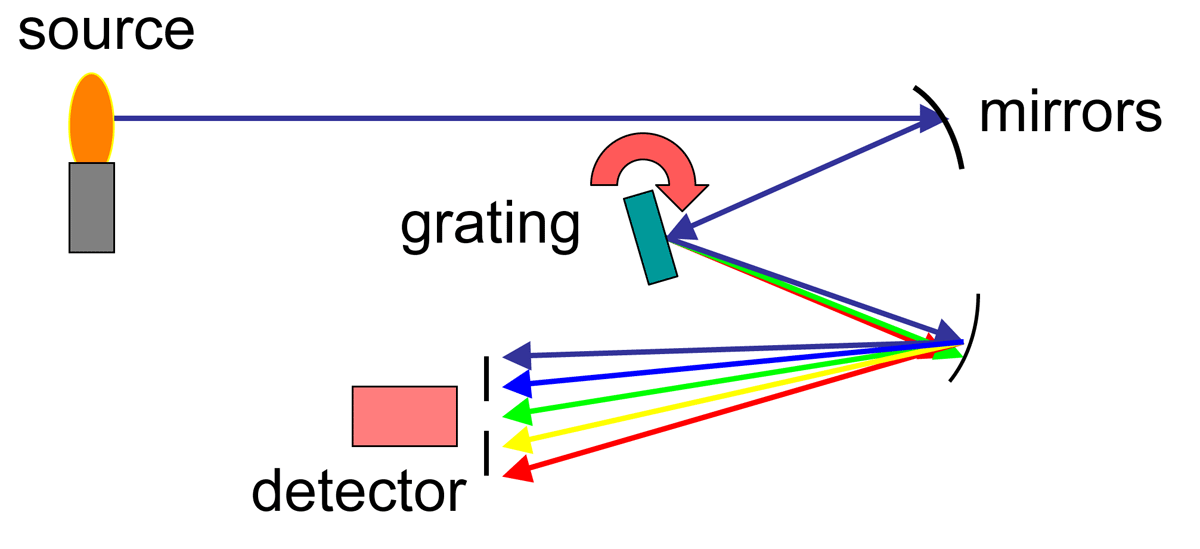
A peristaltic pump draws an aqueous or organic sample into an analytical nebulizer, converting it into a fine mist that is injected directly into the plasma. Inside the flame, the sample molecules shatter into individual atoms, which repeatedly lose and regain electrons amid the swarm of electrons and charged ions, radiating light at wavelengths unique to each element. In some instrument designs, a shear gas—nitrogen or dry compressed air—trims the plasma at a defined point, and one or two transfer lenses focus the emitted light onto a diffraction grating. Other designs route the light through an orifice where a steady argon flow cools and deflects the plasma while letting light pass into the optical chamber, and still others use optical fibers. Once separated into component wavelengths, the light is measured either by photomultiplier tubes aimed at specific element lines or, in newer units, by semiconductor detector arrays such as CCDs. These arrays capture all wavelengths simultaneously, enabling every detectable element to be read in a single pass. The resulting intensities are then interpolated against calibration curves built from known standards, with software corrections applied for matrix interferences.
From Laboratory Curiosity to Commercial Instrument
The journey of ICP-AES from theoretical curiosity to workbench staple spans nearly two decades. The gap between those two milestones underscores how long the method needed to mature before it could handle non-experimental samples reliably. That single product transformed ICP-AES from a specialist's tool into a routine analytical platform, setting the stage for the broad adoption that followed across environmental, geological, forensic, and agricultural science.
Where the Technique Meets the Real World
ICP-AES has quietly become a workhorse across an astonishing range of fields. In food and beverage science, it quantifies metals in wine and tracks arsenic levels in food products. Environmental labs rely on it to screen drinking water and wastewater for metal contamination, and it has largely replaced older gravimetric methods for routine multi-element trace analysis. In minerals processing, the technique supplies grade data for various streams, feeding into mass-balance calculations. In agriculture, it is increasingly the method of choice for determining nutrient levels in soils, which in turn drives fertiliser recommendations aimed at maximising crop yield and quality. Forensic scientists use it to fingerprint soil samples recovered from crime scenes or victims, comparing metal compositions against control samples to strengthen circumstantial evidence. Even motor oil analysis now leans on the technique to reveal how an engine has been operating.
Gallery
Frequently Asked Questions
Who is Atomic emission spectroscopy?
AES is a chemical analysis technique that identifies and measures elements by reading the specific wavelengths of light they emit when excited in a flame, plasma, arc, or spark. It was first established as a practical chemistry tool by Robert Bunsen and Gustav Kirchhoff in the 19th century.
What are Atomic emission spectroscopy's powers and role?
Its core ability is to fingerprint elements by their unique spectral-line wavelengths and quantify them by measuring how bright that emitted light is, since brightness scales directly with the number of atoms present. It operates through several excitation modes, including flame, inductively coupled plasma, spark, and arc.
How does Atomic emission spectroscopy's story end?
Rather than having a single finale, AES continues to play a steady supporting role in modern labs, from checking the chemical composition of metal alloys in foundries to verifying purity in pharmaceutical manufacturing. It remains a go-to method for quality control wherever precise elemental breakdowns are needed.
Why is Atomic emission spectroscopy important?
It gives chemists a fast, direct way to determine both which elements are in a sample and how much of each is present, without needing to isolate individual compounds first. That makes it indispensable in fields ranging from metallurgy to drug analytics.
Who are Atomic emission spectroscopy's creators?
Robert Bunsen and Gustav Kirchhoff are credited as the pioneers who first turned atomic emission into a systematic analytical tool for chemistry. Their foundational work laid the groundwork for every modern AES instrument used in laboratories today.
More in Chemical Analysis And Spectroscopy 1-18
Spotted an error? Know more?
This is a living reference — every entry is fact-audited, and reader corrections feed straight into our audit queue. Suggest an edit · See this site's audit record