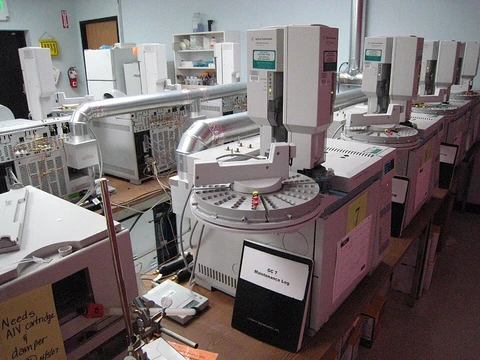
Electroanalytical methods
Techniques measuring potential or current in electrochemical cells.

Electroanalytical methods are a class of techniques in analytical chemistry that study an analyte by measuring the potential (volts) and/or current (amperes) in an electrochemical cell containing the analyte. These methods are categorized into potentiometry, amperometry, and coulometry, depending on which aspects of the cell are controlled and which are measured.
- field
- Analytical chemistry
- known_for
- Measuring potential and current in electrochemical cells to analyze analytes
- main_categories
- Potentiometry, amperometry, coulometry
- common_technique
- Potentiometry using glass-membrane electrode in pH meter
- subclass_of_amperometry
- Voltammetry and chronoamperometry
- subclass_of_voltammetry
- Polarography using dropping mercury electrode
Lore & Background
Potentiometry passively measures the potential difference between two electrodes, one a reference electrode with constant potential and the other an indicator electrode whose potential changes with sample composition. This non-destructive measurement assumes electrode equilibrium with the solution. Indicator electrodes are often made selectively sensitive to the ion of interest, such as fluoride in fluoride selective electrodes. Platinum is commonly used in aquatic environments due to its high electron transfer kinetics, though multi-metal electrodes can enhance kinetics. The most common potentiometric electrode is the glass-membrane electrode used in a pH meter. A variant, chronopotentiometry, uses constant current and measures potential as a function of time.
Reader's Guide
Electroanalytical methods are significant in analytical chemistry for their ability to quantify analytes through electrical signals. Potentiometry offers non-destructive measurement of solution composition, widely applied in pH meters. Amperometry, including chronoamperometry and voltammetry, measures current as a function of time or potential, enabling analysis of reduction potentials and electrochemical reactivity. Voltammetry is practically non-destructive, consuming only a small amount of analyte at electrode surfaces, and can work with microliter volumes and nanomolar concentrations. Coulometry completely converts an analyte from one oxidation state to another, measuring total charge passed to determine concentration or electron transfer numbers. These techniques provide versatile tools for both organic and inorganic sample analysis, with chemically modified electrodes expanding their applicability.
Did You Know?
- Potentiometry is a non-destructive measurement that affects the solution very little.
- Chronoamperometry typically uses microelectrodes and experiment times of 20 ms to 1 s to avoid consuming the analyte.
- Polarography is a subclass of voltammetry that uses a dropping mercury electrode as the working electrode.
- Coulometry includes bulk electrolysis (potentiostatic coulometry) and coulometric titrations.
Defining Role in the Analytical Landscape
Electrochemical methods occupy a distinct position among the modern instrumental approaches that define contemporary analytical chemistry. Alongside spectroscopy, chromatography, and mass spectrometry, they represent one of several pillars through which chemists identify unknown compounds and quantify the presence of specific substances in mixtures, solutions, or gas phases. Where classical techniques like titration and gravimetric analysis once carried the full weight of chemical identification, electrochemical methods now contribute to a broader toolkit capable of expressing results in terms of amount of substance, concentration, percentage by mass, mole fractions, or partial pressure depending on the phase under investigation. This versatility makes them particularly valuable in settings where the analytical question spans multiple physical states or requires the detection of trace components within complex matrices. As a branch of analytical chemistry, electroanalytical work inherits the field's core mission: developing and applying methods that reveal what a material is made of and how much of each component is present, whether the sample is a biological fluid, an industrial alloy, or an environmental extract.
Historical Trajectory and the Rise of Instrumental Analysis
The story of electroanalytical methods is inseparable from the broader arc of analytical chemistry, a discipline that has been essential since chemistry's earliest days. Throughout the twentieth century, basic spectroscopic and spectrometric techniques were discovered in its early decades and refined in its later ones, and by the 1970s, hybrid combinations of multiple techniques became standard for achieving complete sample characterization. Electrochemical methods, as part of this instrumental family, benefited from this same trajectory of refinement and integration, moving from standalone laboratory procedures to components of multi-technique analytical workflows that could tackle increasingly complex questions in both inorganic and organic chemistry.
Interdisciplinary Applications and Expanding Frontiers
One of the most striking features of electroanalytical methods is the extraordinary breadth of fields they now serve. Analytical chemistry, of which electrochemical approaches form a part, extends well beyond the chemistry laboratory into biochemistry, medicinal chemistry, forensic science, archaeology, nutritional science, agricultural chemistry, metallurgy, chemical engineering, and materials science. Since the 1970s, the discipline has grown increasingly inclusive of biological questions, a shift that opened new avenues for electroanalytical techniques in contexts such as histology and the detection of biomarkers in blood. In the pharmaceutical industry, analytical methods support not only quality assurance but also the discovery of new drug candidates and the clinical understanding of how a drug interacts with a patient. In forensic and environmental settings, methods are deliberately kept static over long periods so that data remain comparable across years, a requirement that shapes how electroanalytical protocols are designed and maintained. This cross-sector demand means that an electroanalytical chemist might work on a cancer-risk biomarker one week and an industrial alloy composition the next, reflecting the field's deep entanglement with real-world problems far removed from the academic origins of the discipline.
Digital Transformation and Sustainable Futures
The twenty-first century has reshaped electroanalytical methods through the converging forces of digitalization, automation, and sustainability. The handling of large datasets from high-throughput instruments has made advanced data analysis, including machine learning, an essential companion skill for any analytical chemist, and electrochemical measurements are no exception. Trends toward miniaturization and real-time, point-of-care diagnostic sensors are pushing electroanalytical techniques into settings where traditional laboratory infrastructure is absent, enabling rapid field analysis and continuous monitoring. At the same time, the growing emphasis on sustainability has given rise to Green Analytical Chemistry, a subfield dedicated to minimizing the environmental footprint of chemical analyses—a principle that directly influences how electrochemical methods are designed, from reagent selection to waste management. The integration of chemometrics and bioinformatics with instrumental data further means that the raw electrochemical signal is only the beginning of the analytical story; interpreting it now requires computational fluency alongside wet-lab expertise. Together, these converging trends ensure that electroanalytical methods continue to evolve not merely as a set of laboratory procedures but as a dynamic, data-rich discipline at the intersection of chemistry, engineering, and information science.
Frequently Asked Questions
What are Electroanalytical methods?
Electroanalytical methods are a family of analytical chemistry techniques that identify and quantify a substance by reading the voltage or current in an electrochemical cell that holds the analyte. They are set apart from optical or mass-based approaches because the key signal is purely electrical.
What are the three main categories of Electroanalytical methods?
The field splits into potentiometry, amperometry, and coulometry, each defined by which electrical variable is held fixed and which one is recorded. Potentiometry reads open-circuit potential, amperometry tracks current at a set potential, and coulometry tallies total charge passed during a reaction.
How does Electroanalytical methods actually work in a lab?
The analyte is placed in an electrochemical cell, and the analyst either measures the cell's potential or the current it draws under controlled conditions. That electrical reading is then converted into a concentration or identity for the target species.
What is the most common Electroanalytical methods technique people encounter?
Potentiometry with a glass-membrane electrode, as used in a standard pH meter, is the everyday example most people interact with. The electrode generates a potential proportional to hydrogen-ion activity, so a simple voltmeter reading translates directly into a pH value.
What sub-techniques fall under amperometry in Electroanalytical methods?
Voltammetry and chronoamperometry are the two principal subclasses of amperometry. Voltammetry in turn includes polarography, which uses a dropping mercury electrode to sweep the applied potential and record the resulting current.
More in Chemical Analysis And Spectroscopy 1-18
Spotted an error? Know more?
This is a living reference — every entry is fact-audited, and reader corrections feed straight into our audit queue. Suggest an edit · See this site's audit record