Combustion analysis
Method to determine elemental composition via combustion and product analysis.

Livingjw and HVM · CC BY-SA 4.0
Combustion analysis is a method used in both organic chemistry and analytical chemistry to determine the elemental composition (more precisely empirical formula) of a pure organic compound by combusting the sample under conditions where the resulting combustion products can be quantitatively analyzed.
- inventor
- Joseph Louis Gay-Lussac
- improved_by
- Justus von Liebig
- field
- Organic chemistry, analytical chemistry
- key_elements_analyzed
- Carbon (C), hydrogen (H), nitrogen (N), sulfur (S)
- typical_sample_size
- 0.5 mg (for CHN analysis)
- modern_detection_methods
- Thermal conductivity detection, infrared spectroscopy
Lore & Background
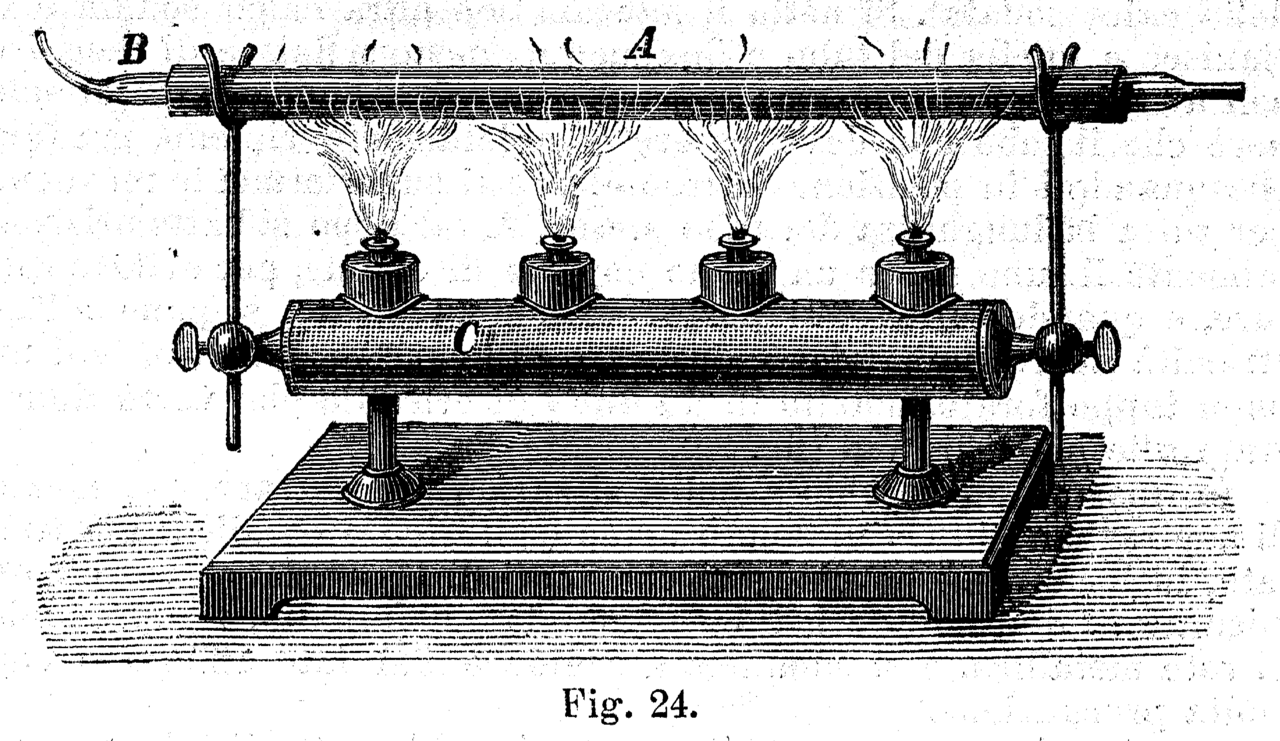
Combustion analysis was invented by Joseph Louis Gay-Lussac. The combustion train, an analytical tool for determining elemental composition, allows the determination of carbon and hydrogen through a succession of steps: combustion of the sample at high temperatures with copper(II) oxide as the oxidizing agent, collection of the resulting gas in a hygroscopic agent (magnesium perchlorate or calcium chloride) to trap generated water, and collection of the remainder gas in a strong base (for instance potassium hydroxide) to trap generated carbon dioxide.
Reader's Guide
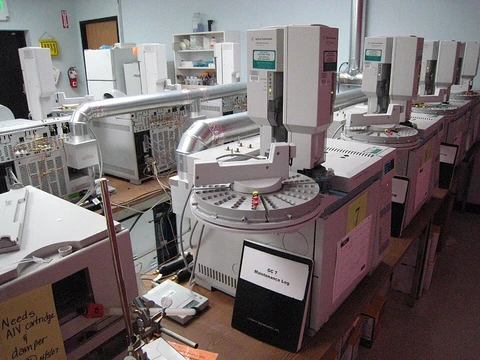
Combustion analysis is significant because it provides a quantitative method for determining the empirical formula of organic compounds, which is fundamental to organic chemistry. The method is applied to elements carbon, hydrogen, nitrogen, and sulfur, converting them to their oxidized forms (CO2, H2O, NO or NO2, and SO2) under high temperature, high oxygen conditions. Notable applications include measuring total nitrogen in food or feed to determine protein percentage, measuring sulfur in petroleum products, and measuring total organic carbon (TOC) in water. Modern CHN analyzers, based on the Dumas method, use flash combustion and detect products via thermal conductivity detection or infrared spectroscopy, handling sample sizes as small as 0.5 mg. The method's legacy includes its widespread use in pharmaceuticals, polymers, chemicals, environment, food, and energy sectors, with manufacturers such as Elementar and LECO Corporation producing automated instruments.
Did You Know?
- Combustion analysis was invented by Joseph Louis Gay-Lussac and improved by Justus von Liebig.
- The combustion train uses copper(II) oxide as the oxidizing agent and traps water with magnesium perchlorate or calcium chloride.
- Modern CHN analyzers can analyze samples as small as 0.5 mg.
- The method converts carbon, hydrogen, nitrogen, and sulfur into CO2, H2O, NO or NO2, and SO2.
Origins and the Long Arc of Instrumentation
Antoine Lavoisier is widely credited with establishing elemental analysis as a rigorous, quantitative experimental discipline for probing the chemical makeup of compounds. In his era, practitioners weighed designated absorbent materials before and after those materials selectively trapped the gases produced by combustion, a painstaking manual procedure that nonetheless laid the conceptual groundwork for the entire field. The landscape has since transformed beyond recognition. Fully automated instruments now detect combustion gases through thermal conductivity or infrared spectroscopy, and a wider family of spectroscopic methods has further broadened the analytical toolkit. The transition from hand-weighed absorbents to electronic, real-time detection stands as one of the most vivid illustrations of how analytical chemistry has modernized, converting what was once a slow, labor-intensive exercise into a rapid, reproducible measurement that can be completed in minutes rather than hours.
CHNX Analysis and Its Place in Organic Chemistry
Among organic chemists, the abbreviation EA almost invariably points to CHNX analysis, the quantification of carbon, hydrogen, nitrogen, and heteroatoms such as halogens or sulfur within a sample. This data has long served two critical purposes: helping researchers deduce the structure of an unknown compound and verifying both the structure and purity of a newly synthesized one. The most prevalent variant, CHNS analysis, is carried out through combustion, and contemporary analyzers can even measure sulfur alongside CHN in a single measurement run. That said, the center of gravity in structural elucidation has shifted considerably. Nuclear magnetic resonance, both proton and carbon-13, mass spectrometry, and chromatographic methods now occupy the primary role in most laboratories. Nevertheless, CHNX analysis retains genuine value as a complementary check, offering an independent confirmation that no other single technique fully replaces.
The Toolkit of Quantitative and Qualitative Determination
Elemental analysis branches into two complementary goals: identifying which elements are present and measuring how much of each is there. On the quantitative side, gravimetry dissolves a sample, precipitates the target element for weighing, or volatilizes it and records the resulting mass loss. Optical atomic spectroscopy, encompassing flame and graphite-furnace atomic absorption as well as inductively coupled plasma atomic emission, probes the outer electronic structure of atoms. Neutron activation analysis takes a different route: neutron capture activates the sample matrix, and the resulting radioactive nuclei decay by emitting gamma rays of characteristic energies, allowing identification and quantification against irradiated standards of known concentration. Qualitatively, inductively coupled plasma mass spectrometry probes atomic mass, while X-ray fluorescence, particle-induced X-ray emission, X-ray photoelectron spectroscopy, and Auger electron spectroscopy interrogate inner electronic structure. Classic wet-chemical approaches such as the sodium fusion test and Schöniger oxidation round out the qualitative arsenal.
From Raw Data to a Verified Formula
Once the analytical run is complete, the interpretive work begins. Practitioners calculate the ratio of elements detected within the sample and then work backward to a chemical formula consistent with those proportions. This step is far more than an academic exercise; it is the principal way a chemist confirms that a delivered sample is indeed the intended compound and that its purity meets expectations. The field has settled on a strict tolerance: results may deviate from the theoretically calculated values by no more than 0.3 percent. Exceeding that threshold signals impurity, an incorrect proposed formula, or an experimental error that must be investigated and resolved. In this sense, the final act of elemental analysis is as much a logical deduction as it is a measurement, bridging the gap between a cloud of spectral or gravimetric data and a single, defensible molecular identity.
Gallery

Frequently Asked Questions
Who is Combustion analysis?
Combustion analysis is a quantitative technique in organic and analytical chemistry that determines the empirical formula of a pure organic compound by burning a small sample and measuring the resulting products. It was originally devised by Joseph Louis Gay-Lussac.
What are Combustion analysis's powers/role?
Its core function is to break a compound down into measurable elements—typically carbon, hydrogen, nitrogen, and sulfur—so chemists can work out the exact elemental ratios. A routine CHN run requires as little as half a milligram of material.
How does Combustion analysis's story end?
The process concludes when the gaseous combustion products are captured and quantified using detectors such as thermal conductivity sensors or infrared spectroscopy. Those final readings are then converted into the compound's empirical formula.
Why is Combustion analysis important?
It remains one of the most reliable ways to confirm the elemental makeup of an unknown organic substance, making it indispensable in both research labs and quality-control settings. Without it, verifying a newly synthesized molecule's formula would be far less straightforward.
Who improved Combustion analysis after its debut?
Justus von Liebig later refined the original Gay-Lussac procedure into a more practical apparatus that became standard in 19th-century laboratories. His version made the technique accessible enough for widespread routine use.
More in Chemical Analysis And Spectroscopy 1-18
Spotted an error? Know more?
This is a living reference — every entry is fact-audited, and reader corrections feed straight into our audit queue. Suggest an edit · See this site's audit record