Dielectric spectroscopy
Measures dielectric properties as a function of frequency.

Д.Ильин : translation · CC0
Dielectric spectroscopy is an experimental method that measures the dielectric properties of a medium as a function of frequency, based on the interaction of an external field with the electric dipole moment of the sample. It is a subcategory of impedance spectroscopy and is used to characterize electrochemical systems by revealing energy storage and dissipation properties through frequency response.
- field
- Electrochemistry, Materials Science, Physics
- known_for
- Measuring dielectric properties and impedance over a range of frequencies to characterize electrochemical systems
- technique_type
- Experimental method
- applications
- Fuel cell testing, biomolecular interaction, microstructural characterization
Lore & Background
Dielectric spectroscopy examines the interaction of an external field with the electric dipole moment of a sample, often expressed by permittivity. It measures the impedance of a system over a range of frequencies, revealing the frequency response, including energy storage and dissipation properties. Data obtained by electrochemical impedance spectroscopy (EIS) is often expressed graphically in a Bode plot or a Nyquist plot.
Reader's Guide
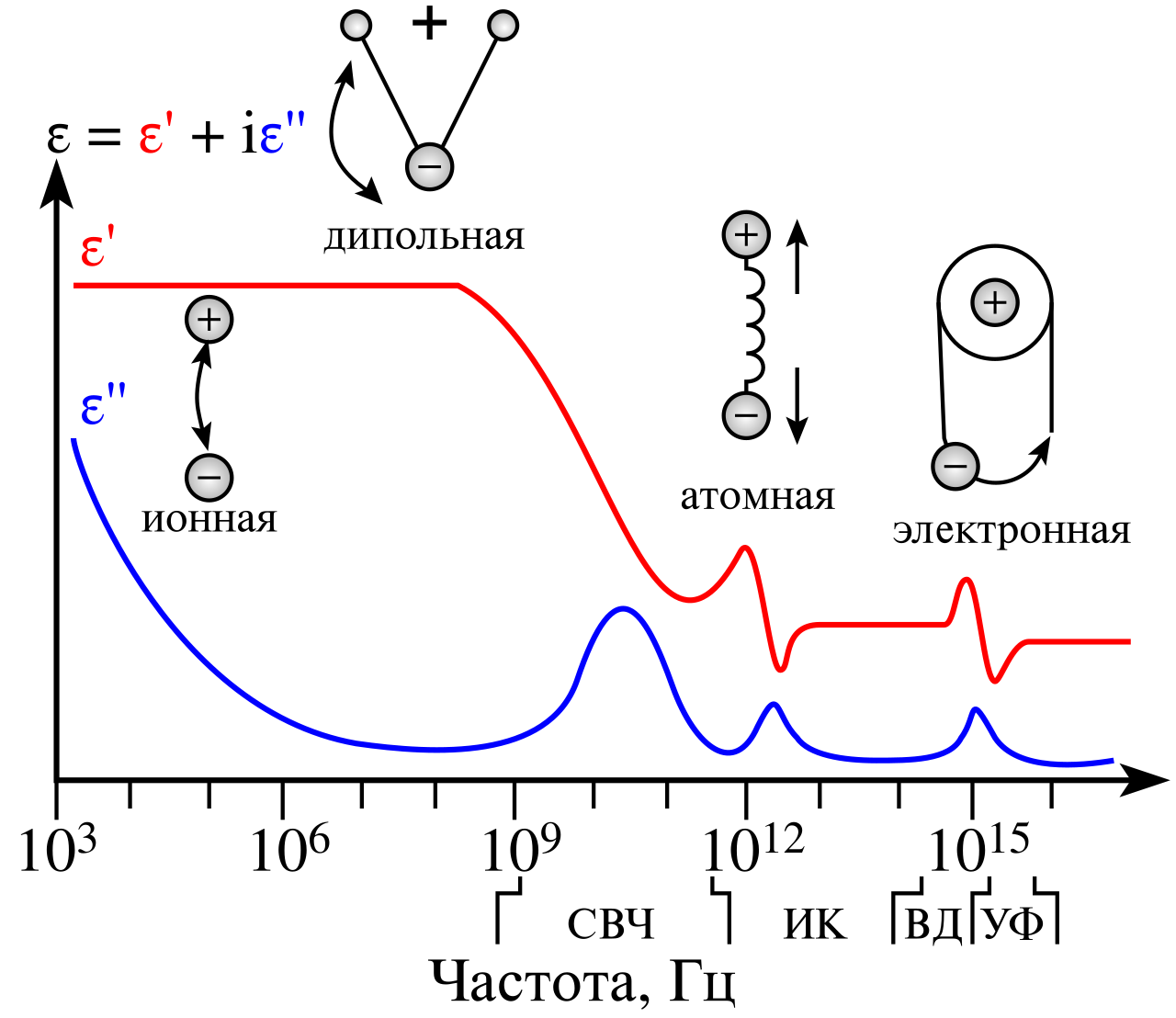
Dielectric spectroscopy has grown tremendously in stature and is now widely employed in scientific fields such as fuel cell testing, biomolecular interaction, and microstructural characterization. It reveals information about the reaction mechanism of an electrochemical process: different reaction steps dominate at certain frequencies, and the frequency response can help identify the rate limiting step. The technique covers various dielectric mechanisms, including electronic polarization, atomic polarization, dipole relaxation, and ionic relaxation, each centered around its characteristic frequency. Dielectric relaxation as a whole results from the movement of dipoles and electric charges due to an applied alternating field, usually observed in the frequency range 10^2-10^10 Hz. The faradaic impedance of an electrolyte-electrode interface is the joint electrical resistance and capacitance at that interface, and the dynamic behavior of a redox reaction is characterized by the charge transfer resistance.
Did You Know?
- Dielectric spectroscopy is a subcategory of impedance spectroscopy.
- Data obtained by electrochemical impedance spectroscopy (EIS) is often expressed graphically in a Bode plot or a Nyquist plot.
- Dielectric relaxation is usually observed in the frequency range 10^2-10^10 Hz.
- EIS can help identify the rate limiting step of an electrochemical process.
Core Measurement Philosophy
Dielectric spectroscopy sits within the broader family of impedance spectroscopy and fundamentally probes how a material's internal electric dipoles respond to an oscillating external field. Rather than recording a single static property, the technique sweeps the applied frequency and tracks how the medium's permittivity shifts across that range. The underlying physics is elegant: an alternating field tugs on the charge distribution inside the sample, and the degree to which those charges follow the field—whether they lag, overshoot, or settle—encodes rich structural information. In a purely resistive system the opposition to alternating current is simply resistance, but real materials combine dissipative elements (resistors) with energy-storing elements (capacitors), producing a complex impedance. This dual character means a single frequency sweep simultaneously reveals how much energy the system stores and how much it dissipates, making the technique a uniquely informative window into the physico-chemical behavior of the sample under investigation.
Hierarchy of Dielectric Mechanisms
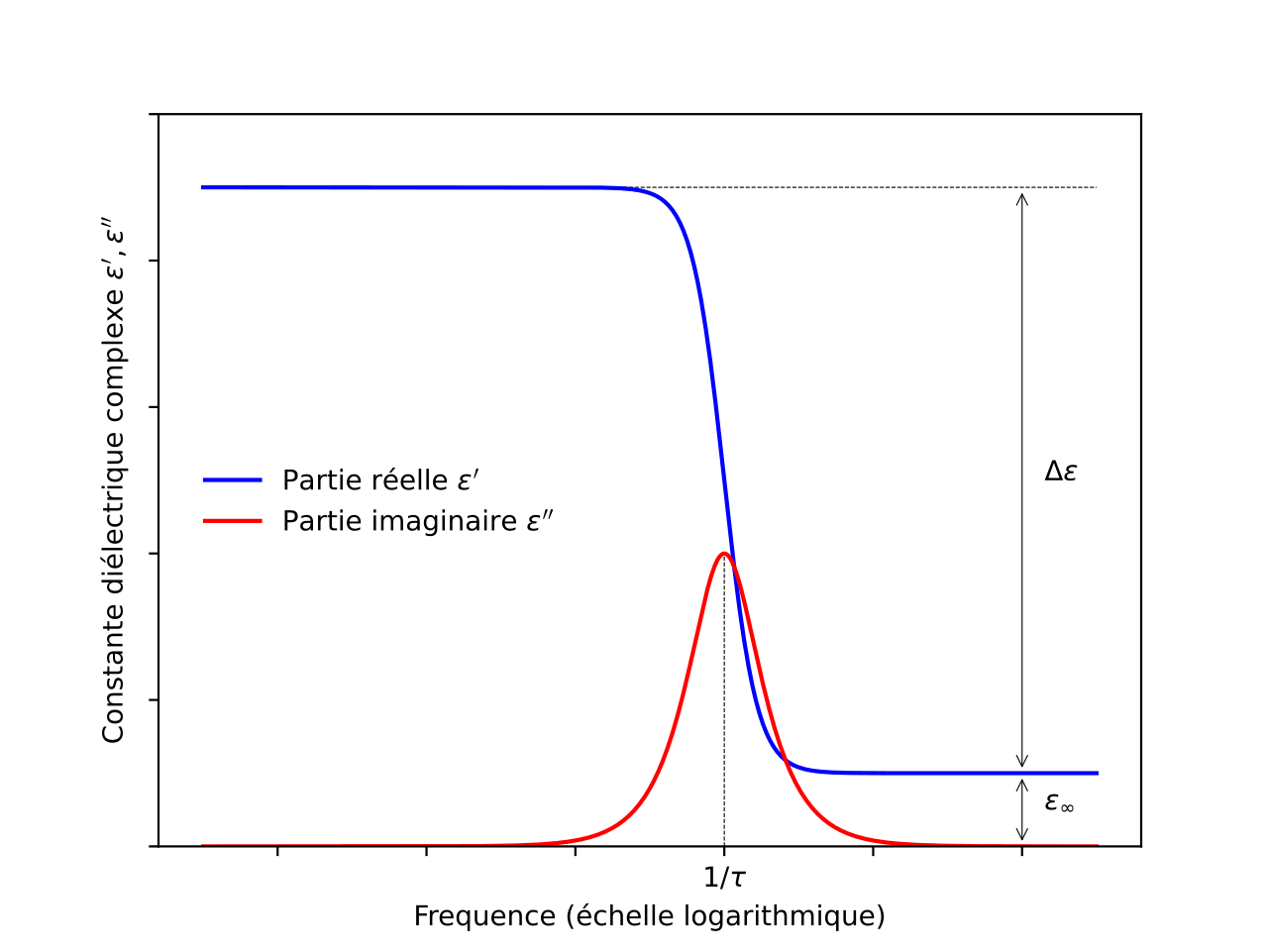
A medium's response to an applied field is not monolithic; it arises from several distinct mechanisms, each anchored to its own characteristic frequency—the reciprocal of the process's characteristic time. At the highest frequencies, electronic polarization dominates: the field displaces an atom's electron cloud relative to its nucleus, a purely resonant effect governed by the balance between restoring and electric forces. Slightly lower down, atomic polarization appears as the nucleus itself reorients, though this contribution is typically small compared to the electronic one. Moving into the relaxation regime, dipole relaxation takes over: permanent and induced dipoles attempt to align with the field, but thermal noise constantly scrambles their orientation, and the relaxation time is set by local viscosity, making this mechanism highly sensitive to temperature, pressure, and chemical environment. At the lowest frequencies, ionic relaxation and conductivity emerge, with charge carriers migrating or becoming trapped at interfaces in heterogeneous materials. Together these mechanisms span roughly 10² to 10¹⁰ Hz, well below the 10¹² Hz threshold of molecular vibrations.
Electrochemical Characterization and Mechanistic Insight
Beyond bulk material characterization, dielectric spectroscopy—commonly called electrochemical impedance spectroscopy (EIS) in this context—has become a cornerstone for probing electrochemical systems. By measuring impedance across a frequency range, the technique exposes the full frequency response of a cell or electrode, cleanly separating energy-storage from energy-dissipation contributions. The resulting data is commonly rendered as a Bode plot or a Nyquist plot, where each arc or slope can be linked to a specific physical or chemical process. One of the most powerful aspects is mechanistic insight: in a multi-step electrochemical reaction, different elementary steps dominate at different frequencies, and the frequency at which a particular feature appears can identify the rate-limiting step. The steady-state behavior of a redox couple, for instance, is described by the Butler–Volmer equation, which relates current density to overpotential through exchange current density and anodic and cathodic transfer coefficients. EIS extends this picture by revealing how those kinetics unfold dynamically across the entire frequency spectrum.
Versatility and Modern Scientific Reach
What distinguishes dielectric spectroscopy from many other analytical techniques is its extraordinary breadth of applicability. Because virtually any physico-chemical system possesses both energy-storage and energy-dissipation properties, the method can be turned on electrochemical cells, mass-beam oscillators, composite materials, and even living biological tissue. In heterogeneous or multiphase systems—composites, for example—dielectric spectroscopy frequently uncovers a universal dielectric response, a power-law relationship between impedance (or its inverse, admittance) and the angular frequency of the applied field. Over recent years the technique has grown substantially in stature and is now routine in fuel-cell testing, biomolecular interaction studies, and microstructural characterization of advanced materials. Its ability to non-destructively interrogate internal structure, interfacial charge trapping, and Maxwell-Wagner-Sillars polarization at both mesoscopic and macroscopic scales makes it an indispensable tool spanning physics, chemistry, materials science, and biophysics.
Gallery
Frequently Asked Questions
Who is Dielectric spectroscopy?
Dielectric spectroscopy is an experimental technique that probes how a material's electric dipoles respond to an applied field across a sweep of frequencies. It sits within the broader family of impedance spectroscopy and is a staple tool in electrochemistry, materials science, and physics.
What are Dielectric spectroscopy's powers/role?
Its core ability is to extract energy-storage and energy-dissipation characteristics of a sample by tracking dielectric behavior over a wide frequency range. This lets researchers fingerprint electrochemical systems, microstructural features, and biomolecular interactions without destroying the specimen.
How does Dielectric spectroscopy's story end?
The 'ending' is a complete frequency-response profile—typically a complex impedance or permittivity plot—that reveals relaxation times, conductivity contributions, and interfacial effects in the material under study. That dataset then feeds into models of fuel-cell performance, phase transitions, or molecular binding events.
Why is Dielectric spectroscopy important?
It gives scientists a non-destructive window into how charges move and polarize inside a medium, which is critical for designing better fuel cells, understanding biomolecular recognition, and mapping microstructural changes in materials. Without it, many electrochemical and physical processes would remain invisible to standard single-frequency measurements.
What 'team' or crew does Dielectric spectroscopy belong to?
It is classified as a subcategory of impedance spectroscopy, placing it squarely in the electrochemistry and materials-science camps. Its methodology draws on physics principles of dipole-field interaction and is widely adopted across fuel-cell testing, microstructural characterization, and biomolecular-interaction studies.
More in Chemical Analysis And Spectroscopy 1-18
Spotted an error? Know more?
This is a living reference — every entry is fact-audited, and reader corrections feed straight into our audit queue. Suggest an edit · See this site's audit record